AI Coding Agent Costs in 2026: Compress Tokens Without Losing Quality
GitHub's latest Copilot engineering note shows why the best AI coding tools reduce repetitive noise, preserve evidence, and measure efficiency across the whole workflow.
In This Article
This article covers AI Coding Agent Costs in 2026: Compress Tokens Without Losing Quality. GitHub's latest Copilot engineering note shows why the best AI coding tools reduce repetitive noise, preserve evidence, and measure efficiency across the whole workflow.
Key Takeaways
- Published: September 3, 2026
- Category: AI Developer Tools
- Tags: AI coding, GitHub Copilot, Developer Productivity, Software Tools, Workflow Automation
- Views: 222
- Reading time: ~14 min read
"GitHub's latest Copilot engineering note shows why the best AI coding tools reduce repetitive noise, preserve evidence, and measure efficiency across the whole workflow."
AI coding assistants are moving from novelty to everyday infrastructure, and the next competitive question is no longer just whether a model can write code. It is whether the whole agent loop can stay fast, affordable, and trustworthy while reading logs, searching files, running tests, and asking for recovery context. GitHub's recent engineering write-up on making Copilot more cost efficient explains a subtle but important shift: token savings that look impressive in isolation can hurt task quality if they remove details the agent later needs. The useful lesson for developers is that cost control must be measured at the workflow level, not only at the prompt level.
For readers comparing productivity utilities, mobile developer helpers, note tools, or file managers, the same principle applies. A tool that feels lightweight for one action may become expensive in attention when it hides context, forces rework, or makes verification harder. BTTC's software catalog is built around that practical evaluation mindset: choose tools by the job they complete, the evidence they preserve, and the friction they remove.
TL;DR: efficient agents compress noise, not evidence
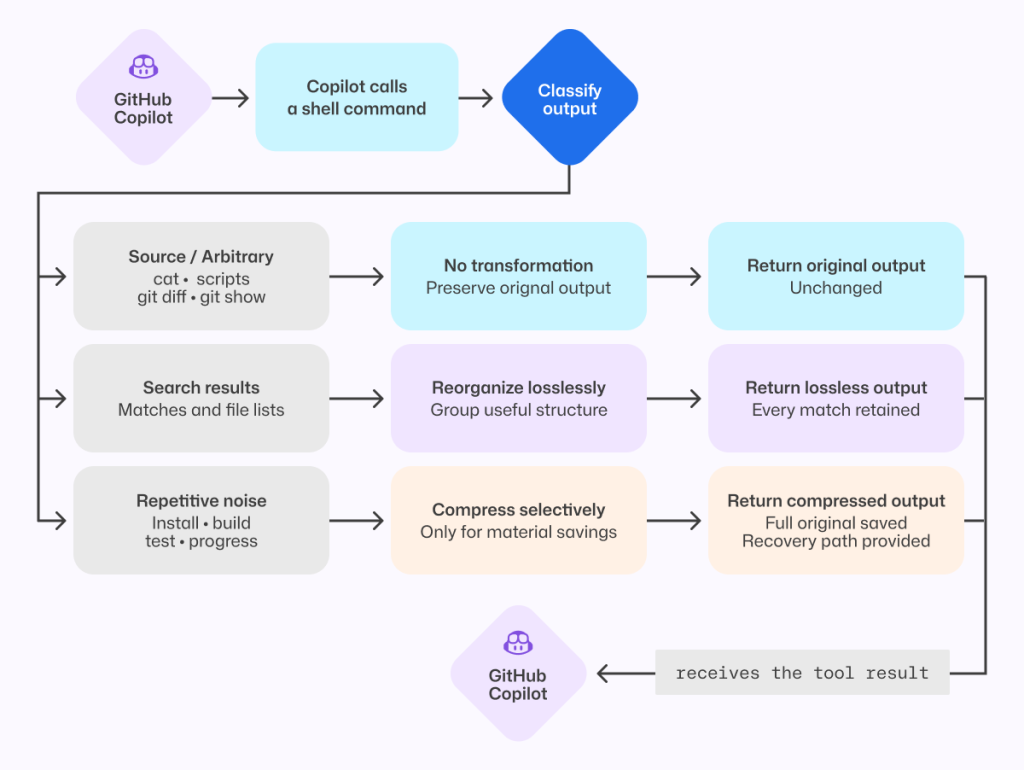
The best AI coding workflows reduce repeated noise while keeping source code, error messages, and recovery paths available. GitHub describes techniques such as classifying shell output, reorganizing search results without dropping matches, and selectively compacting repetitive build or install logs. That is different from blindly summarizing everything. Blind compression can erase the clue that would have fixed the bug, which then creates extra turns, extra tokens, and extra time.
A useful mental model is simple: compress what is redundant, preserve what is decision-critical, and make the original detail recoverable. Developers should ask whether an assistant can show the complete command output when needed, whether it records what was changed, and whether its smaller context still passes real tests.
Why token cost is now a product-quality issue
Every agentic coding session creates a chain of small costs. The model reads instructions, scans files, calls tools, processes terminal output, edits code, and validates the result. Long logs and duplicated context can inflate that chain quickly. But the cheapest run is not always the shortest prompt; it is the run that finishes correctly with the fewest recovery cycles.
This is why GitHub's post matters beyond Copilot. It reframes efficiency as a product-design problem. If a system shortens a test log but loses the first failing assertion, the agent may rerun commands or make a wrong edit. If it preserves every line forever, costs rise and useful context gets buried. The winning design sits between those extremes: structured compaction with clear rules about what cannot be removed.
What developers should evaluate before adopting an AI coding tool
Start with observability. Can you inspect the steps the assistant took? Can you see command output, patches, and test results? Next, test recovery. When the assistant is wrong, can it reopen the original evidence, or is it trapped inside its own summary? Finally, measure end-to-end results. Track whether the tool reduces merged defects, review time, and repetitive work, not just how quickly it generates a first answer.
Teams should also check privacy and permission boundaries. AI tools often need access to repositories, issue trackers, terminals, or cloud logs. Efficiency is not a reason to grant unlimited access. The right setup gives the assistant enough context to solve the task while limiting secrets, production data, and destructive commands.
A practical checklist for lower-cost AI coding sessions
Use smaller tasks with explicit success criteria. Ask the assistant to inspect before editing. Prefer commands that produce focused output, such as a targeted test file or type check, before running a large build. Keep stable project instructions in a short, maintained agent guide instead of repeating them in every prompt. When logs are long, allow compaction only if the full log can be recovered.
Developers working from phones or tablets can apply the same discipline to everyday utilities: save source links, keep exportable notes, and favor tools that make verification easy. If you are looking for Android utilities that support focused work, browsing BTTC's software reviews and download links can help you compare options without installing random copies from unsafe sources.
How this affects SEO, docs, and content teams
AI coding efficiency is not only for engineers. Documentation teams using AI to update changelogs, app pages, and support articles need the same guardrails. Generated text should cite trusted sources, preserve version numbers, and keep screenshots or links attached to claims. For content workflows, the cost risk is often hidden in translation and review loops: a weak summary can create seven weak localized articles, while a complete brief creates synchronized, useful pages.
BTTC's broader technology blog will keep covering these workflow changes because better tooling decisions compound. The tools that win in 2026 will not simply generate more text or more code; they will preserve enough evidence for humans and agents to trust the result.
FAQ
Does token compression make AI coding assistants less accurate?
Not automatically. Compression helps when it removes repeated or low-value noise while preserving errors, source snippets, and recovery access. It becomes risky when it hides the exact evidence needed to debug a problem.
Should small teams care about AI coding cost?
Yes. Even when subscription pricing hides token details, inefficient workflows show up as slower reviews, repeated prompts, and less reliable automation. Small teams benefit from tools that complete tasks cleanly instead of generating impressive first drafts.
What is the safest way to test an AI coding assistant?
Give it a contained issue, require it to explain its evidence, run the real test suite, and review the patch. A good assistant should improve throughput without weakening code review, security, or rollback practices.
Conclusion
The next wave of AI coding tools will be judged by completed work, not raw prompt size. GitHub's discussion of cost-efficient Copilot workflows is a timely reminder that compression should protect developer attention while preserving evidence. Choose assistants and productivity software that keep the original context recoverable, make validation visible, and reduce total rework rather than merely shrinking the first answer.