LLM Evaluation Before Production: A Practical Checklist for AI Tools
GitHub's latest LLM evaluation guidance is a useful blueprint for teams and power users who want to test AI tools before trusting them in production workflows.
In This Article
This article covers LLM Evaluation Before Production: A Practical Checklist for AI Tools. GitHub's latest LLM evaluation guidance is a useful blueprint for teams and power users who want to test AI tools before trusting them in production workflows.
Key Takeaways
- Published: September 1, 2026
- Category: AI Software
- Tags: LLM evaluation, AI tools, production AI, developer workflow, software testing
- Views: 381
- Reading time: ~12 min read
"GitHub's latest LLM evaluation guidance is a useful blueprint for teams and power users who want to test AI tools before trusting them in production workflows."
TL;DR
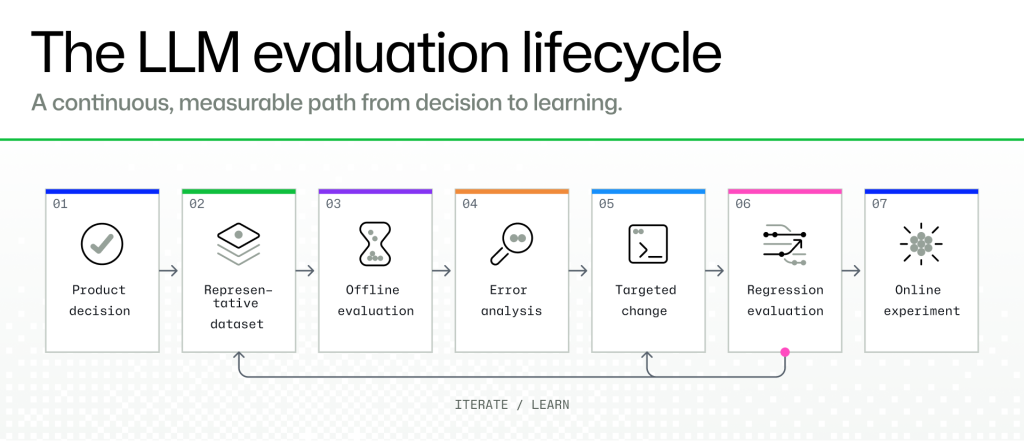
GitHub's new guide to evaluating LLMs before production is a timely reminder that AI tools should not be selected by demo quality alone. The useful pattern is a loop: define the product decision, build representative examples, run offline tests, inspect errors with humans, make targeted changes, repeat regression checks, and only then expand usage. For BTTC readers, the same logic applies when comparing coding assistants, document summarizers, automation tools, or any AI utility listed in a software catalog.
Why LLM evaluation is a high-interest topic now
AI features are moving from experiments into everyday work. Teams use them to review pull requests, summarize documents, write support answers, classify tickets, search code, and automate repetitive tasks. At the same time, model choices are multiplying across GitHub Copilot, cloud APIs, local models, browser agents, and workflow automation products. That creates a practical search question: how do you know an AI tool is good enough before it touches production work?
The GitHub article matters because it turns evaluation into an operating system rather than a one-time benchmark. It argues for representative data, explicit success criteria, human review where confidence is low, and regression tests after every change. Those ideas are evergreen because every new model release creates the same decision again.
Start with the decision, not the model
The most common mistake is to begin with a leaderboard or a flashy product launch. A stronger evaluation begins with the decision you need to make. Are you choosing an assistant for code search, a bot for support replies, a summarizer for long PDFs, or an agent that can edit files? Each job has different risks. A code tool must preserve tests and explain diffs. A support bot must avoid confident policy mistakes. A research assistant must cite sources and separate facts from guesses.
Write the decision in one sentence before comparing tools. Then gather examples that resemble real usage: messy prompts, edge cases, multilingual input, old files, missing context, and sensitive workflows that should be rejected. This keeps the evaluation grounded in work instead of marketing.
Build a small but honest test set
You do not need a giant benchmark to improve AI decisions. You need examples that reveal likely failure modes. Include easy cases, ambiguous cases, high-impact cases, and examples where the correct answer is to ask for clarification or refuse unsafe action. If you are evaluating software for personal productivity, save ten to thirty real tasks and score how each candidate performs. If you are evaluating for a team, label expected outputs and document why those labels are correct.
Human review is still important. GitHub's lifecycle highlights triage for low confidence, model-label disagreement, and high-impact cases. That prevents a metric from hiding dangerous behavior. It also creates a better dataset over time because every reviewed failure becomes a future regression test.
Turn evaluation into a software workflow
The best AI evaluation process looks like normal software quality work. Keep prompts, datasets, model settings, and scoring notes under version control. Run offline tests before changing a prompt or swapping a model. After a targeted change, rerun old cases to make sure the fix did not break another task. For higher-risk use cases, add an online experiment with limited traffic and a clear rollback path.
This is where tool choice matters. A good AI workflow needs editors, test runners, note systems, browser utilities, PDF tools, and security helpers that make evidence easy to capture. If you are building that stack, the BTTC software catalog is a useful place to compare practical utilities before downloading.
Checklist before trusting an AI tool
Use this short checklist before putting an LLM product into a real workflow. First, define the exact task and the cost of a wrong answer. Second, create a representative test set instead of relying on vendor examples. Third, score both quality and behavior: accuracy, citations, latency, cost, refusal quality, privacy, and ability to recover from mistakes. Fourth, inspect failures with a human reviewer, especially when the output affects users, money, security, or legal obligations. Fifth, repeat regression tests after every prompt, model, or tool change. Sixth, document the rollout boundary so the tool cannot quietly expand into riskier work.
For individual users, the same checklist applies in simpler language. Try the app with non-sensitive files, compare results against a trusted source, check permissions, keep a manual backup, and avoid connecting accounts until the tool proves value.
FAQ
Is LLM evaluation only for developers?
No. Developers need formal tests, but everyday users can still compare AI apps with real tasks, source checks, permissions review, and small trial runs.
What is the biggest warning sign in an AI tool?
A tool that gives confident answers without sources, review controls, logs, or a rollback path should not be trusted with important work.
How often should teams rerun evaluations?
Rerun them whenever prompts, models, retrieval sources, permissions, or product behavior changes. New model releases should be treated like software changes, not magic upgrades.
Conclusion
LLM evaluation is becoming a normal part of software selection. The winning teams will not be the ones that adopt every new model first; they will be the ones that test with representative work, learn from failures, and connect AI tools to controlled workflows that humans can still verify.