Gemini Agent Evaluations Are GA: A Practical Checklist for Production AI Workflows
Google’s Gemini Enterprise Agent Platform now has generally available agent and model evaluations. Here is how teams can use metrics, simulations, and human review before trusting AI workflows in production.
In This Article
This article covers Gemini Agent Evaluations Are GA: A Practical Checklist for Production AI Workflows. Google’s Gemini Enterprise Agent Platform now has generally available agent and model evaluations. Here is how teams can use metrics, simulations, and human review before trusting ...
Key Takeaways
- Published: August 1, 2026
- Category: AI Tools
- Tags: Gemini Enterprise, AI agents, agent evaluation, developer tools, AI workflow automation
- Views: 493
- Reading time: ~15 min read
"Google’s Gemini Enterprise Agent Platform now has generally available agent and model evaluations. Here is how teams can use metrics, simulations, and human review before trusting AI workflows in production."
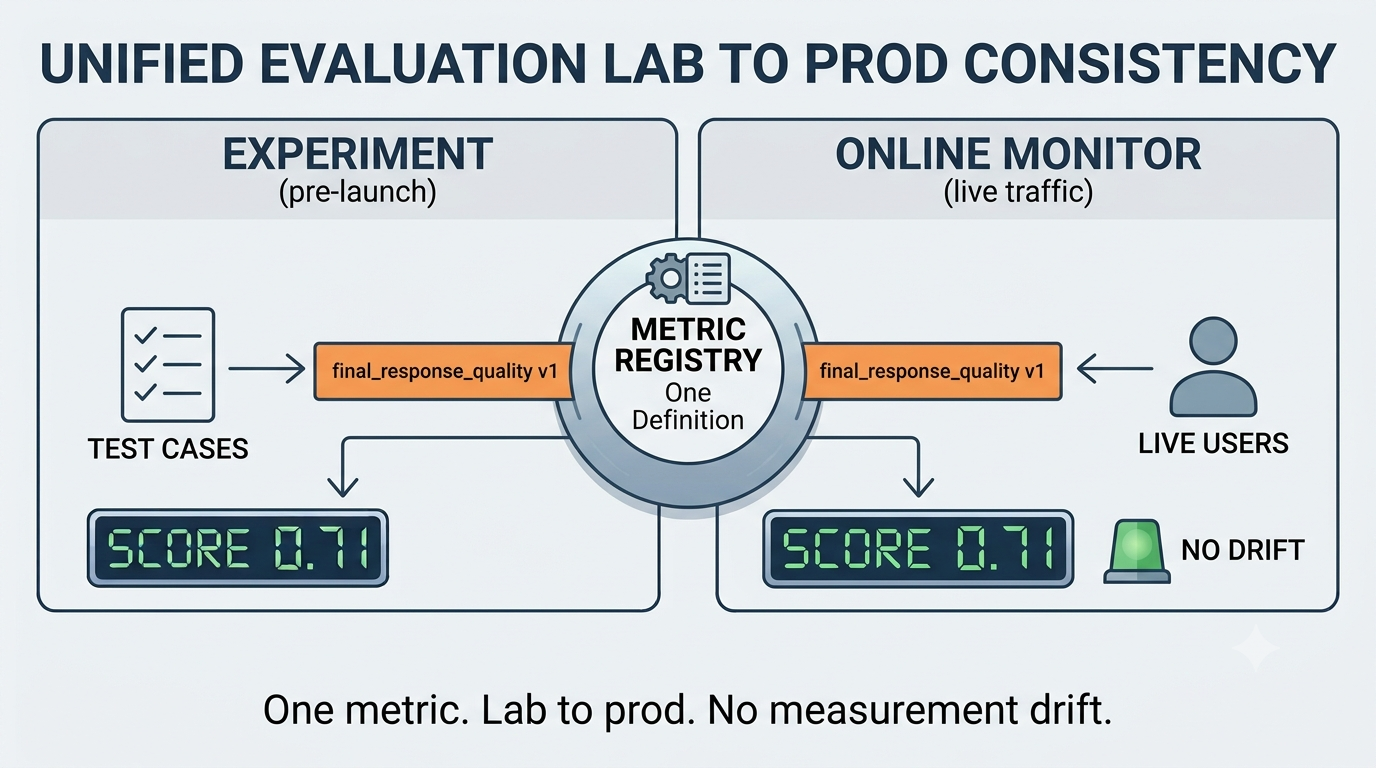
Google's announcement that Agent and Model Evaluations in Gemini Enterprise Agent Platform are generally available is a useful milestone for anyone building AI agents in 2026. The most important part is not the branding. It is the signal that agent evaluation has moved from optional research hygiene to day-to-day product infrastructure. Teams can now measure agent quality with pre-built metrics, adaptive rubrics, custom code-based checks, LLM-as-a-judge workflows, simulators, SDK support, agents-cli integration, and versioned registries that fit into development and production feedback loops.
That matters because many agent projects fail after the demo. A prototype can summarize a file, draft a response, or call a tool once. A production agent must stay reliable across messy inputs, permission boundaries, multi-turn conversations, tool failures, user corrections, and model upgrades. The official Google Developers announcement describes evaluation as a unified engine across local experiments and live traffic. For BTTC readers, the practical takeaway is clear: before you let an AI workflow touch customer data, publish content, or orchestrate productivity tools, build a repeatable evidence loop. You can also browse the BTTC software directory when you need dependable PDF, file, media, and productivity utilities around an agent workflow.
Why agent evaluation is suddenly a product requirement
AI agents are different from traditional chatbots because they do more than produce text. They choose tools, remember context, perform steps, ask for clarification, and sometimes trigger real-world actions. That extra autonomy creates value, but it also creates hidden failure modes. An agent may answer correctly in a short test and still fail when the user changes the order of instructions, uploads a malformed document, or asks for an action outside policy.
Evaluation turns those vague risks into observable signals. Instead of arguing about whether an agent “feels better,” teams can track completion rate, instruction following, tool-call accuracy, safety refusals, latency, cost, grounding quality, and recovery from failed steps. A versioned metric registry also helps teams avoid changing the yardstick every time a new prompt or model is tested. When everyone can see the same score history, it becomes easier to decide whether a release is an improvement or just a more confident mistake.
What the Google GA announcement changes
Google's post highlights more than a dashboard. The evaluation service is positioned as a system that works during local development and after deployment. That is important because the biggest regressions often appear only when real users provide unexpected combinations of intent, language, formatting, and files. Pre-built metrics are useful for common checks, while adaptive rubrics and custom code-based metrics let teams encode domain-specific expectations. LLM-as-a-judge evaluation can be valuable when the output is qualitative, but it should be paired with deterministic tests for facts, permissions, formats, and tool side effects.
The built-in user and environment simulators are especially relevant for multi-turn agents. A single prompt test cannot prove that an agent can handle a sequence such as receive a file, classify it, extract fields, call a tool, ask for approval, and write a final receipt. Simulation gives teams a way to test realistic paths before exposing a workflow to customers.
A practical evaluation checklist for AI workflows
Start with the jobs your agent is allowed to do. Write them as narrow tasks: summarize a support ticket, convert a document into a checklist, compare two pieces of text, prepare a release note, or route a file for review. For each job, define the expected input, allowed tools, forbidden actions, success criteria, and fallback behavior. Then create a small golden set of examples that includes easy cases, edge cases, hostile prompts, missing data, unsupported formats, and multilingual requests.
Next, split your evaluation into layers. Use deterministic tests for schema validation, links, file names, permissions, and exact calculations. Use rubric-based scoring for tone, usefulness, completeness, and whether the agent followed the user's priority. Use human review for high-impact actions and for calibrating judge prompts. Finally, run the same set after every model upgrade, prompt change, tool change, or retrieval-index refresh. If a release improves average quality but breaks a critical safety scenario, it should not ship automatically.
How this connects to everyday software selection
Agent evaluation is not only for enterprise AI platforms. Solo creators, marketers, educators, and small software teams can apply the same thinking with lightweight tools. If an agent prepares blog drafts, evaluate source attribution, internal links, image choices, localization completeness, and whether the final article sends readers to relevant resources such as the BTTC blog. If an agent handles files, check that the file converter, compressor, PDF utility, or screenshot tool produces stable results before making the agent responsible for coordination.
This is where tool discovery still matters. AI can orchestrate work, but dependable software performs many of the concrete steps. A strong workflow might use an agent to plan the task, a trusted utility to process the file, a validator to verify the result, and a human reviewer to approve publication or delivery. That combination is more realistic than expecting one model call to be creative, correct, safe, and operationally aware at the same time.
FAQ
Do small teams need formal agent evaluations?
Yes, but they do not need to start with a large enterprise program. A spreadsheet of representative tasks, expected outcomes, pass/fail checks, and notes can catch many regressions before a workflow reaches users.
Are LLM-as-a-judge metrics reliable enough?
They are useful for qualitative review, but they should not be the only gate. Pair them with deterministic tests for facts, formats, permissions, URLs, files, and actions that can be verified exactly.
What should be evaluated before an agent uses external tools?
Test whether the agent chooses the right tool, passes safe parameters, handles tool errors, avoids unauthorized actions, records the result, and asks for human approval when impact is high.
Conclusion
The Gemini Enterprise Agent Platform GA announcement is a reminder that the next phase of AI agents will be judged by reliability, not novelty. Teams that build evaluation loops now will ship safer automations, choose better tools, and recover faster when models or prompts change. The winning pattern is simple: define the job, measure the behavior, keep trusted software in the loop, and promote only the workflows that can prove they are ready.

