Agentic Documentation Workflows: How to Keep Product Docs in Sync
GitHub’s cross-repo documentation example shows how AI agents, GitHub Actions, and human review can close the gap between shipped features and usable docs.
In This Article
This article covers Agentic Documentation Workflows: How to Keep Product Docs in Sync. GitHub’s cross-repo documentation example shows how AI agents, GitHub Actions, and human review can close the gap between shipped features and usable docs.
Key Takeaways
- Published: July 13, 2026
- Category: NEWS
- Tags: AI, Developer Tools, Documentation, GitHub, Software Workflow
- Views: 434
- Reading time: ~13 min read
"GitHub’s cross-repo documentation example shows how AI agents, GitHub Actions, and human review can close the gap between shipped features and usable docs."
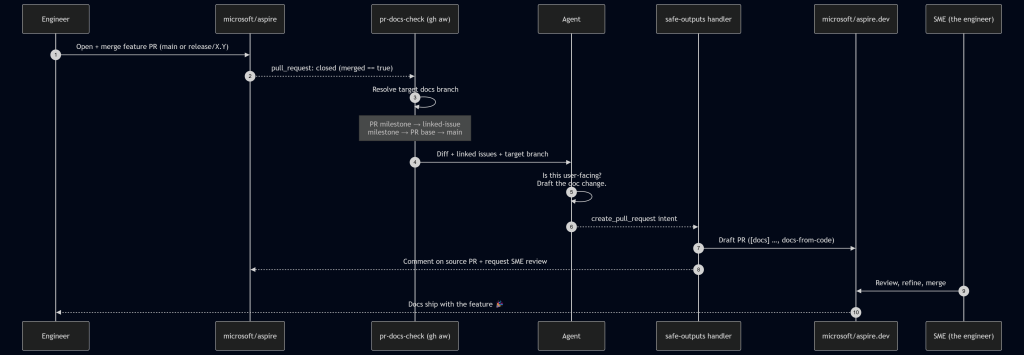
GitHub’s latest agentic workflow case study focuses on a common software problem: product teams ship features faster than documentation teams can explain them. In GitHub’s write-up on automating cross-repo documentation, the Aspire team connects a merged product pull request to a documentation pull request in another repository. An agent drafts the docs change, GitHub Actions coordinates the workflow, and subject-matter experts still review the result before publication.
That pattern is important because it avoids the weakest version of AI documentation: asking a chatbot to invent a help article after the release is already live. A more reliable agentic documentation workflow begins with the actual code change, release intent, issue context, API diff, and product terminology. The agent can then produce a first draft that is close enough for a human reviewer to correct, rather than forcing the documentation owner to start from a blank page. For teams exploring tools in the BTTC software directory, this is also a useful evaluation lens: effective productivity software should not simply generate text; it should preserve context, handoff, review, and accountability.
TL;DR: AI docs should be treated as a release workflow, not a writing shortcut
Agentic documentation is most useful when it is triggered by real development events. A merged pull request can carry enough context for an AI agent to draft a doc update, open a reviewable pull request, and notify the people who understand the feature. The result is not fully autonomous publishing. It is a faster path from code change to reviewed documentation.
Why documentation drift is a growth problem
Documentation drift hurts more than internal efficiency. It damages onboarding, search traffic, support deflection, and user trust. If a new feature ships without updated docs, developers search for answers, find outdated pages, and assume the product is unfinished. If a product page promises a capability but the guide does not show how to use it, conversion drops. This is especially painful for developer tools, AI tools, PDF utilities, automation apps, and mobile productivity software where users compare alternatives quickly.
The GitHub example is clickable because it gives teams a practical operating model. Instead of treating docs as a separate backlog, the workflow makes documentation part of the release system. A product change can trigger a doc-draft check. The generated pull request can link back to the original implementation. Reviewers can inspect the same evidence that created the draft. That makes the output easier to trust and easier to improve.
What an agentic documentation workflow needs
A reliable workflow should include four pieces. First, it needs a trustworthy trigger, such as a merged pull request, a release branch, or a labeled issue. Second, it needs source context: changed files, commit messages, API references, screenshots, and existing docs. Third, it needs constraints that tell the agent what kind of page to update, which style guide to follow, and what not to publish. Fourth, it needs a human approval step, because documentation often carries product positioning, legal meaning, and support expectations.
This is where many AI experiments fail. Teams give the model access to a repository but do not define the handoff. The agent writes a generic explanation, misses the exact user journey, or updates the wrong page. The more useful design is narrower: draft the smallest documentation change that explains the feature, cite the files or pull request that justify it, then ask the right owner to review.
How teams can start without overbuilding
Small teams do not need a complex multi-agent platform on day one. Start with a checklist: every release pull request should answer whether docs are needed, which page should change, and who owns the review. Then add automation around the highest-friction step. For example, an action can collect the merged diff and ask an agent to draft a markdown update. Another action can open a draft pull request in the docs repository. A reviewer can then accept, rewrite, or close the draft.
Teams that compare developer utilities on BTTC Blog should look for the same principle across AI tools: does the tool create a reviewable artifact, or does it only produce a disconnected answer? Reviewable artifacts are easier to test, version, translate, and reuse. That matters for documentation, but also for support macros, changelogs, release notes, test plans, and product tutorials.
FAQ
Does agentic documentation replace technical writers?
No. It changes where writers spend time. Instead of chasing every product change manually, writers can review drafts, enforce structure, improve examples, and protect the user experience.
What is the biggest risk?
The biggest risk is publishing confident but inaccurate documentation. Keep the agent in draft mode, require review, and make every generated change traceable to source evidence.
Which teams benefit first?
Teams with frequent releases, multiple repositories, API changes, and a documentation backlog can benefit early because the workflow reduces handoff delay.
Conclusion
Agentic documentation is not just another AI writing trick. It is a release-quality workflow that connects product changes, source evidence, draft generation, and expert review. GitHub’s example shows a practical direction for software teams in 2026: use agents to shorten the distance between shipping a feature and explaining it clearly, while keeping humans responsible for accuracy and trust.


